
Tell Me a Story
by Stephanie Whetstone
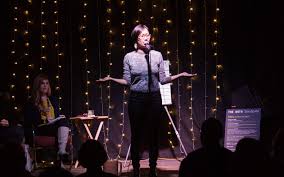 Spend time with any toddler, and you will inevitably be asked for a story: to tell one or to read one, then another and another. You may even be asked to tell the same story over and over! Little humans crave stories, perhaps because stories teach us how to be human and how to interact with other humans (or, in the case of science fiction, how to relate to creatures from another planet). Scientists such as Paul Zak have recently shown that stories teach our brains to favor empathy. Perhaps that is why we continue asking to read, watch, and hear stories, even as adults.
Even as we write and read more and more in the semi-connected spheres of social media and the Internet, live storytelling events have begun to blossom in popularity. The palpable human connection and excitement of the “Story Slam,” or live storytelling competition, has spread. At Princeton, Princeton Writes and Humans of Princeton have hosted story slams modeled after one of the oldest live storytelling programs, The Moth, founded by George Dawes Green. The Moth’s tagline sums up the premise of the slams. They feature “true stories told live.”
Whether you are writing a story or telling it, the basic elements of a good story — character, setting, plot, point of view, tone, and dialogue — are all important. In telling your story, however, you are a performer as well and must make a physical impression and form a direct connection with the other humans in the room. Green jokes, “You can’t smell anybody, it’s not real human interaction.” At a slam, you are immersed in a story with all of your senses.
After presenting more than 15,000 stories through The Moth, Green has found a common thread to good storytelling: vulnerability. “A good raconteur talks about failure, their own human failure, and frailty,” he says. Great stories often address how we attempt to overcome problems, big and small.
Since The Moth was founded in 1997, StoryCorps, Story Lab Chicago, Public School (in Los Angeles), and massmouth in Boston have found audiences hungry for the human connection inherent in live storytelling. On campus, we’ve hosted a Valentine’s story slam focused on “first love” and a fall slam focused on gratitude. We have a wealth of great storytellers on campus! If you’d like to develop your story writing or storytelling skills, please visit us at Princeton Writes, where we think there’s nothing better than a good story.
(To learn more about The Moth, check out Stav Ziv’s “Have We Got a Story for You: 18 Years of Storytelling at The Moth” in Newsweek, June 30, 2015.)