Dinner Discussion with Amy Waldman on April 4

2016-03-31T17:51:02-04:00

Journalist and novelist Amy Waldman will discuss her twofold calling over dinner in Mathey College's private dining room on Monday, April 4, from 7:00-8:00 p.m. Co-hosted by Princeton Writes, the Walter Lord Society, and the Writers Studio and geared to undergraduates, "The Whole Truth: Telling Stories Through Journalism and Fiction" will explore how writers can develop their voices in both genres, probing the possibilities of each.  How, for example, can fiction transcend the limitations of journalism to tell a fuller story? When can journalism provide greater clarity than fiction? Waldman is a visiting lecturer in the Council of the Humanities and [...]
Dinner Discussion with Amy Waldman on April 42016-03-31T17:51:02-04:00

A Restless Language

2020-01-14T14:10:01-05:00

A Restless Language One of the delights – and occasional frustrations – of English is its protean quality, its limitless capacity to embrace and abandon words and usages. In 2011, an article in Science, “Quantitative Analysis of Culture Using Millions of Digitized Books” (courtesy of Google), estimated that our lexicon grew by some 8,500 words per year between 1950 and 2000, though many of these additions will never make it into a dictionary. Even as words are born or employed in new ways, others wither from disuse, and what was familiar and acceptable to our grandparents may well be alien to us, and vice versa. Take the [...]

A Restless Language2020-01-14T14:10:01-05:00

ennui (ŏn-WĒ)

2016-03-28T12:00:25-04:00

Definition (Noun) The feeling of mental weariness and dissatisfaction produced by want of occupation, or by lack of interest in present surroundings and employments. In Context "Young men reaching maturity in deferential and patriarchal societies found a soldier's career attractive precisely because it promised release from the restraints or ennui of the familiar." Dennis Showalter and William J. Astore, Soldiers' Lives Through History: The Early Modern World, 2007.

ennui (ŏn-WĒ)2016-03-28T12:00:25-04:00

alliaceous (ăl-ē-Ā-shəs)

2016-03-21T12:00:15-04:00

Definition (Adjective) Of a smell or taste: resembling that of garlic or onions, garlicky; also having such a smell or taste. In Context "In the Middle Ages in southern Europe, food tended to be alliaceous because garlic helped disguise the fact that warm temperatures had turned some of the ingredients bad." Mark Morton, Cupboard Love: A Dictionary of Culinary Curiosities, Second Edition, 2004.

alliaceous (ăl-ē-Ā-shəs)2016-03-21T12:00:15-04:00

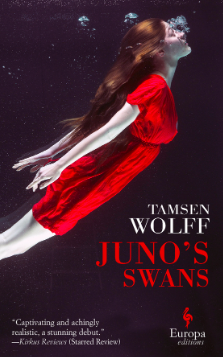
Juno’s Swans (2018) by Tamsen Wolff

2019-09-12T15:07:44-04:00

Critical Evaluation “Juno’s Swans by Tamsen Wolff is not a traditional queer “first love” novel. It’s not a story about becoming and it doesn’t contain bromides about the magic of new love. What it offers instead is a story about the limits of love: both the crash at the end of a first love, and the tunnel vision infatuation can give, the kind where everything outside that adoring gaze becomes flattened. Juno’s Swans gives us Nina, a high school senior washed ashore from a summer in Cape Cod in which she went to an acting residency, fell madly in love with Sarah, [...]

Juno’s Swans (2018) by Tamsen Wolff2019-09-12T15:07:44-04:00

taciturn (TĂS-ĭ-tûrn)

2016-03-14T12:00:20-04:00

Definition (Adjective) Characterized by silence or disinclination to conversation; reserved in speech; saying little; uncommunicative. In Context "There were times when she was taciturn, but I thought she was still grieving for her mother." Julia Miles, Editor, WomensWork: Five New Plays from The Women's Project, 1989.

taciturn (TĂS-ĭ-tûrn)2016-03-14T12:00:20-04:00

paucity (PÔ-sĭ-tē)

2016-03-07T12:00:48-05:00

Definition (Noun) Smallness of quantity or size; thinness; the presence of something in only small amounts; scantiness; a small or scant quantity. In Context "He had the best library for miles around, yet still there was a paucity of books, a paucity that he turned into an opportunity." Robert L. Dorman, A Word for Nature: Four Pioneering Environmental Advocates, 1845-1913, 1998.

paucity (PÔ-sĭ-tē)2016-03-07T12:00:48-05:00

The Baron in the Trees (1959) by Italo Calvino

2016-03-01T01:00:04-05:00

Critical Assessment "Calvino, it seemed to me, had managed effortlessly what no author in English could quite claim: his novels and stories and fables were both classically modernist and giddily postmodern, embracing both experiment and tradition, at once conceptual and humane, intimate and mythic. Calvino, with his frequent references to comics and folktales and film, and his droll probing of contemporary scientific and philosophical theories, had encompassed motifs associated with brows both high and low in an internationally lucid style, one wholly his own." Jonathan Lethem, "Italo for Beginners," The New York Times, November 20, 2005. First Excerpt "I have mentioned [...]

The Baron in the Trees (1959) by Italo Calvino2016-03-01T01:00:04-05:00

Contact Info

B03 New South Building, Princeton University

Phone: 609.258.9980

Go to Top