
Community of Writers: Pooja Makhijani
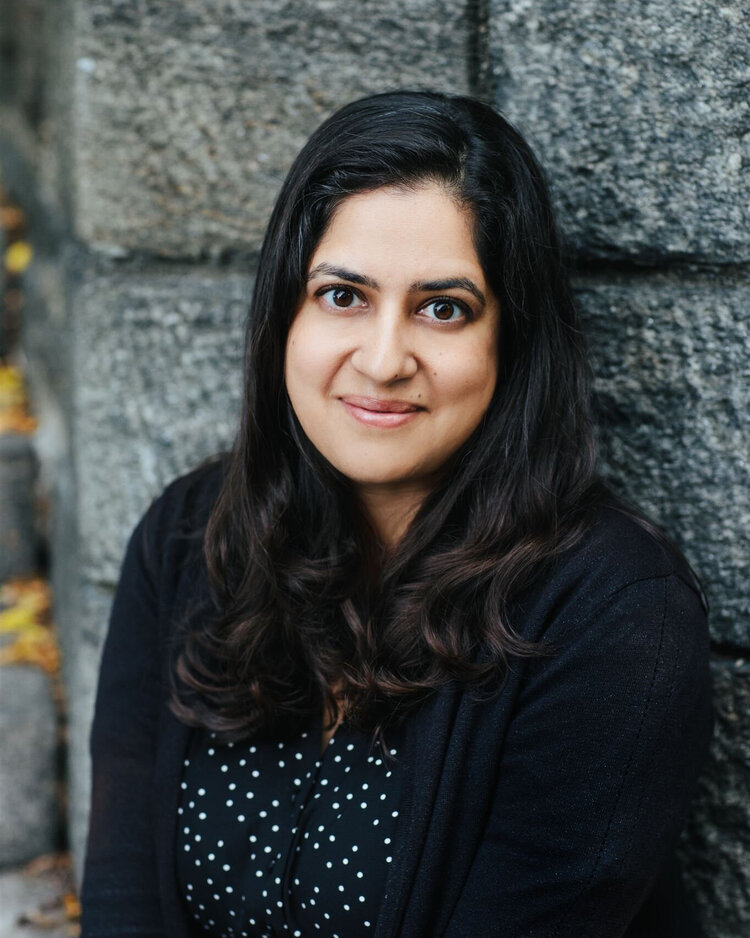 Pooja Makhijani is Communications Manager at the Princeton Institute for International and Regional Studies. She is the editor of Under Her Skin: How Girls Experience Race in America, an anthology of essays by women that explores the complex ways in which race shapes American lives and families. She is also the author of Mama’s Saris, a picture book. Her bylines have appeared in The New York Times, The Village Voice, The Washington Post, NPR, Real Simple, The Atlantic, WSJ.com, The Cut, Teen Vogue, Parents, VICE, Bon Appétit, Saveur, BuzzFeed, and espnW among others. She holds a B.S. from Johns Hopkins University and an M.F.A. in creative writing from Sarah Lawrence College, and has been in residence at SPACE on Ryder Farm. Aside from reading and writing, she likes to bake. Find more at www.poojamakhijani.com; here, she speaks with Princeton Writes about her creative process and offers a snippet of her linked essay “The Path to an American Dream, Paved in Vienna Fingers,” which was was named Notable in The Best American Food Writing 2019.
What draws you to writing?
I can’t remember a time in which I didn’t write. When I was younger, it was making up stories, and I journaled all my life. I have so many diaries from my teenage years, which will forever remain unshared with the world, I hope! So I feel like writing has always been some sort of outlet, a way to creatively express myself. And I’ve always been a reader. I can’t remember a time when my nose wasn’t in a book.
Who is your audience?
I write across several genres. I write for children and I think that for them, because I’m a person of color — and historically, at least in American publishing, children of color have been so underrepresented in the genre — whenever I write for them, I’m thinking of the kid I was. And now [as an adult] I’m definitely thinking, “Oh, I have a child who reads! A lot!” And so I’m thinking of those children. While representation has gotten better since I was a kid, it’s still really hard to find. Most of the books that are published still feature white, mostly male, young protagonists — or sometimes animal protagonists as well, there are lots of animals — but not children who are not that. In an increasingly multicultural country, that’s frustrating.
When I write non-fiction, I do a lot of personal essays and creative non-fiction. Then, I’m really interested in exploring topics that people may be uncomfortable writing about, a kind of undoing, or challenging, of taboos. So I’ve written about postpartum depression and motherhood, unpaid labor, divorce, single parenting, so topics that are also on the margins, in some ways. So I think I’m writing for people who need to read that.
What is your writing process?
I’m someone who has a day job, and as someone who’s also a parent, and a single parent, I steal time whenever I can. I have a Google Doc, tapping away when my daughter’s in dance class, getting that half-hour away, or early in the morning, before she wakes up. Sometimes in bed! I wish I could be one of those writers who gets up every morning at like 3 in the morning and did whatever, but my life’s just not conducive to that. And so I steal moments whenever I can, and I think there’s a lot of value in saying, “Oh, I have 15 minutes here!” Because I may not have that block of five hours to write every morning.
What is it about the world you want to capture or change through writing?
I’m trying to create a more just world. Saying, “These things are unequal, these things could be better,” and really trying to address those injustices in our world, in some ways. As a writer of color, you get pigeonholed in some ways. Depending on your cultural or racial or ethnic background, there are acceptable stories that exist in the marketplace, that are available, because the publishing world is still largely white. This is just the nature of mainstream publishing in the United States. For a lot of people, that’s limiting; they just don’t want to write only about things that come from their cultural, ethnic, or racial background, or have characters who are only from places or cultures that they are familiar with. I get that! On the flip side, I feel like there’s so many of our stories that haven’t been told. So I feel like for me, as a writer of color, I want to continue to tell stories about children of color, people of color, because I think that’s the thing that drives me whether the stories are publishable or not. I think we have so many stories to tell. I have so many stories to tell! So I don’t feel limited as an artist. I think publishing is what’s limiting us. Obviously, without a platform — we can go back-and-forth about what that means in terms of being fulfilled as an artist.
Who are your favorite writers?
Oh boy, that’s so hard! I really like Arundhati Roy, who writes brilliantly across genres as well. Some of her recent work [is] called “The Pandemic Is A Portal.” It just came out a few weeks ago; it’s a really beautiful piece about what the virus [COVID-19] might look like in India right now, in a very charged political situation. But then she transcends that: what can we imagine? How can we write about some of the injustices being laid bare by this pandemic? Whether that’s socioeconomic or racial or even gendered: who’s doing most of the labor right now? [She] has a moral righteousness in a good way, without being polemical.
The other recent thing that pops into my head is a woman — and we are friends; we do know each other — and her name is Sayantani DasGupta. She has a middle-grade series out now; the third book just came out in March, and it’s a trilogy called the Kiranmala and the Kingdom Beyond Trilogy. It’s about this little girl who’s 12 years old and it’s a quest narrative. What’s really amazing about these books is that she combines science and the immigrant narrative into a fantasy novel, and she has American and South Asian pop culture references as well as Bengali folktales, and the character’s background is Bengali-American. She creates this amazing, amazing trilogy of books! I have been reading them to my daughter and they’re some of the best young adult literature that I’ve read of late, period.
Interview by Elizabeth Durham
Photo courtesy of Pooja Makhijani
The Path to an American Dream, Paved in Vienna Fingers
To my immigrant grandmother, it was not suburban homeownership or her son’s corporate job or her grandchildren’s college plans that encapsulated the American dream. It was Vienna Fingers.
The cookies were a mainstay of my childhood.
My paternal grandmother, Mama, who helped raise me in a multigenerational home in New Jersey, always had Vienna Fingers in Tupperware containers in her room. She would divide a package of cookies into two piles: one of intact, sandwiched cookies and the other of plain wafers with the vanilla-flavored cream cleanly scraped off. I do not know what happened to this excess of cream. She ate the cream-free ones at teatime, each dipped in sugary, hot chai… (read full text at The Path to an American Dream, Paved in Vienna Fingers).